
Surveys On The Go App Review – Scam or Legit?
Welcome to my Surveys on the Go review!
Surveys On The Go claims you can get paid for taking quick and simple surveys on your smartphone.
Sounds straightforward enough. But if you’ve spent any time in the survey app space, you already know the gap between what these apps promise and what they actually deliver can be enormous. Some pay pennies. Some never pay at all. And some quietly suspend your account the moment you’re about to cash out.
So where does Surveys On The Go actually fall?
Want to Get Paid for Playing Games on Your Phone?
I tested and compared the best reward apps and sites, so you don't waste time on the fake ones. See which ones actually pay, how low the cash-out minimums go, and which offers are worth your time.
- ✅ Low cash-outs, some from just $1
- ✅ PayPal, gift cards and more
- ✅ Games, surveys and simple tasks
- ✅ Honest tips to avoid tracking problems
Earnings aren't guaranteed and results vary. Treat it as a bonus for time you already spend on your phone.
I did a deep dive into this one — including how it works, how much you can realistically earn, what’s changed recently, and what real users are saying in 2025. Here’s the honest truth.
Surveys On The Go Review
- Name: Surveys On The Go
- Website: https://www.surveysonthego.com
- Price: Free to join
- Company: MFour Mobile Research, Inc
- Payout methods: PayPal, Venmo, Amazon gift cards, Visa prepaid cards
- Minimum cashout: $10
- Similar apps: QuickThoughts, MOBROG, Zap Surveys
- LEGITIMATE
- Overall Rating: 3.5/5
What is Surveys On The Go?
Surveys On The Go (SOTG) is a mobile market research application developed by MFour Mobile Research, Inc. — a legitimate U.S.-based company founded in 2011 that works directly with Fortune 500 brands to gather real consumer insights.
That distinction matters more than it might seem. Unlike many reward apps that act as middlemen for anonymous third-party data brokers, MFour operates its own research platform and has direct relationships with the brands commissioning the studies.
In practice, that means the surveys you take on SOTG are often more meaningful — and better compensated — than what you’ll find on generic survey sites.
Brands need to know how real consumers interact with their products in the real world, and MFour positions SOTG as the tool that captures that at what it calls the “Point-of-Emotion®” — ideally right when you’ve just left a store, used a product, or made a purchase decision, while the experience is still fresh.
The app has been downloaded more than 2.5 million times and currently holds a 4.5-star rating from over 70,000 reviews on the App Store.
For a survey app, that’s a genuinely strong reputation. It’s been around for over a decade, it pays in real cash (not points), and it hasn’t shown the kind of payment manipulation or account suspension patterns that typically follow fake cash apps.
But none of that means it’s perfect — or that the earnings are impressive. Let’s get into the details.
Pros and Cons
Pros
- Operated by a credible U.S. market research firm with direct brand relationships.
- Pays in real cash — no points system to decipher.
- More payout options than before: PayPal, Venmo, Amazon gift cards, and Visa prepaid cards.
- Pays $0.10 even if you’re disqualified — which adds up if you’re active.
- Product testing opportunities that most survey apps simply don’t offer.
- Payday feature provides passive weekly income just for keeping data sharing active.
- Bonus Gigs offerwall gives you something to do between surveys.
- Trustworthy — account suspensions are rare and not a reported pattern.
- Fast PayPal payouts once you hit the $10 threshold.
Cons
- Survey frequency is low — typically 1 to 4 per week, sometimes fewer.
- Qualifying is genuinely difficult and time-consuming.
- Survey length often exceeds the estimated time.
- Approval process can take 3-5 days after completion.
- Passive Payday earnings are very small on their own.
- Not available outside the US.
How Does It Work?
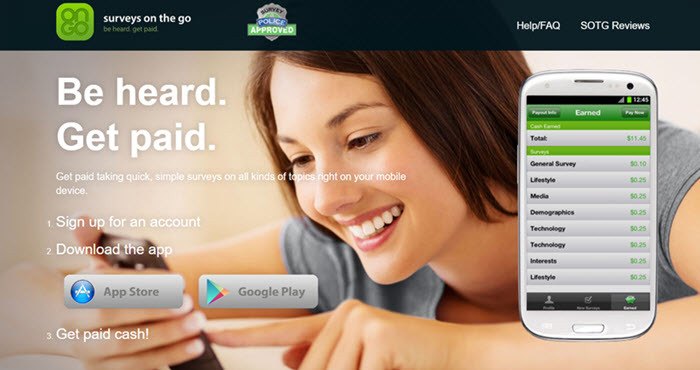
Download and Registration
SOTG is available on both Android and iOS. Registration is quick — just create an account with your email, complete a basic profile, and you’re in. The minimum age is 18.
One thing worth doing immediately: fill in your profile as completely as possible. Your demographic data — household size, income bracket, shopping habits, product categories you use — determines which surveys you’ll be sent. A sparse profile means fewer and lower-paying invites.
A complete one means better matches from the start. It’s the single most important setup step on the whole platform.
Also make sure to enable location permissions. A significant portion of SOTG’s most valuable surveys are location-triggered — meaning the app detects you’ve just left a store or venue and sends you a survey about that specific experience while it’s still fresh. Without location access, you’ll miss these entirely.
Taking Surveys
When a new survey is available that matches your profile, the app sends you a push notification.
From there, you’ll typically go through a short qualification screener first to confirm you’re the right respondent. Pass the screener, and you move on to the full survey.
Fail it, and you receive a $0.10 disqualification payment — which is a small but genuine gesture of respect that most survey apps don’t bother with.
Standard surveys pay between $1 and $5, and some specialist or longer studies pay $10 or more. That’s meaningfully higher per survey than you’d typically see on platforms like Survey Junkie or even Swagbucks. The trade-off is volume — SOTG is a quality game, not a quantity game. You might get 3 or 4 survey invites in a given week, not 30.
The harder truth is that qualifying is genuinely difficult. If you’re not the exact demographic a brand needs — the right age, gender, household type, shopping habits, car owner, pet owner, whatever the screener is checking for — you’ll get rejected. Expect to spend time that doesn’t always pay off.
This isn’t unique to SOTG; it’s an industry-wide reality. But it’s worse when surveys are already infrequent to begin with.
Survey Approval
After completing a survey, your submission goes through a review process that typically takes 3 to 5 days. Surveys can be rejected for vague answers, unclear media submissions (for surveys requiring photos or video), profanity, or not following instructions. As long as you answer thoughtfully and follow any instructions carefully, rejections are uncommon — but they do happen, so it’s worth keeping in mind.
Product Testing — The Feature That Sets SOTG Apart
Here’s where Surveys On The Go genuinely differentiates itself from the competition, and it’s something most reviews don’t spend nearly enough time on.
MFour runs what the research industry calls Home Use Tests (HUTs) — studies where brands send you a real, physical product to test at home, then pay you for your feedback afterward.
Most survey apps treat product testing as an occasional bonus. SOTG has built much of its infrastructure around it, and the volume of product testing opportunities available here is significantly higher than on platforms like Survey Junkie or Swagbucks.
Here’s how the typical product testing workflow goes. First, you receive a notification for a screener survey — usually paying $0.50 to $1.00 — that asks qualifying questions like “Do you own a washing machine?” or “Do you drink sparkling water?” or “Have you purchased razor blades in the past 30 days?”
If you fit the criteria, the app asks for your shipping address. Shipping is completely free. A box arrives at your door within one to two weeks containing a full-sized product — sometimes an unreleased prototype, sometimes a reformulation of something you’d recognize from a store shelf.
You use the product for a set period (usually a few days to a few weeks), then receive a follow-up survey asking for detailed feedback. That follow-up survey pays the bulk of the reward. Testers have reported receiving everything from shampoo and air fresheners to razor blades and tech accessories — and getting paid $10 to $25 for the testing process, while getting to keep the product.
The important caveats: not everyone who passes the screener will be selected, since there’s a limited number of test units available per study. And the brand is kept confidential until the product arrives (sometimes even after). But if you do get selected, product testing is by far the highest-value activity on the platform — both financially and in terms of actual interest.
Payday — Passive Income for Sharing Your Data
One of the more significant features added to SOTG in recent years is Payday — a passive income program that pays you weekly micropayments simply for keeping your data-sharing active.
You grant the app permissions (location, digital surveys, and accessibility/VPN depending on your device), and every week you’ll receive a small cash reward added directly to your balance.
The weekly amounts are modest — think cents rather than dollars. But the key word here is passive.
You don’t have to do anything beyond keeping the permissions enabled. For users who are active on the app anyway, it’s essentially free money that accumulates in the background.
Selected users can also be invited to upgrade to Payday+ — an invite-only premium version of the program that offers 50% higher micropayments. It requires the same permissions as the standard program, so if you receive an invitation, it’s generally worth accepting.
It’s worth being transparent about what this feature involves: you’re sharing your location and app usage data with MFour in exchange for payment
. MFour is upfront about this in their privacy policy, and it’s the same data that powers their research business.
Whether that feels like a fair trade is a personal call — but at least the arrangement is clearly disclosed, which is more than can be said for many apps that collect the same data without paying you anything.
Bonus Gigs — Something to Do Between Surveys
Survey frequency has always been SOTG’s biggest limitation, and MFour has clearly heard the feedback. Their response is Bonus Gigs — a built-in offerwall that lets you earn cash by completing third-party tasks between surveys.
These tasks typically include reaching certain levels in mobile games, signing up for fintech apps, or trying out subscription services.
The payout rates mirror what you’d find on the offerwalls of bigger platforms like Swagbucks, and they can meaningfully accelerate how quickly you reach the $10 cashout threshold.
A few important notes: stick to free-to-play game offers where possible and treat paid subscription offers with caution — read the terms carefully before committing to anything that requires a payment or credit card.
That advice applies to offerwalls everywhere, but it’s especially worth repeating for users who might be new to this format.
Location-Based Surveys — The “Point-of-Emotion” Difference
One of MFour’s most interesting features is its location-triggered survey technology. The app can detect when you’ve just left a specific retail location — a grocery store, a car dealership, a fast food restaurant, a shopping mall — and instantly push you a survey about that experience while it’s still fresh in your mind.
This is valuable to brands for an obvious reason: the closer to real-time a survey is, the more accurate the data. And it’s valuable to users because these location-based surveys often pay better than standard opinion surveys, since they capture behavioral data tied to an actual visit.
This is exactly why enabling location permissions isn’t optional if you want to maximize earnings on SOTG. Without it, you’re locked out of a category of surveys that can pay $2 to $5 for a 5-minute questionnaire completed right after leaving a store. Over time, that adds up considerably more than most users realize.
How Much Can You Earn?
Let’s be straight about this: SOTG is not a serious income source. You’re not going to replace a job with it, and most users won’t earn more than $10 to $20 per month from surveys alone. Some users report taking two to three months to reach the $10 minimum cashout, especially if survey availability in their area is low.
That said, the picture looks notably better when you combine all the earning methods. A realistic breakdown for an active user might look something like this: standard surveys deliver $5 to $15 per month depending on qualification rates; product testing adds $10 to $25 on months when you’re selected (and free products worth more than that); Payday passive income adds a few dollars weekly; and Bonus Gigs can fill in the gaps when surveys are slow. Stack all of that together consistently, and reaching $30 to $50 per month isn’t unrealistic — though it requires effort and some luck with product testing invites.
The per-survey rate is genuinely better than most competitors. A $3 survey that takes 10 minutes is a $18/hour rate — and $10+ product testing surveys are even stronger. The problem is simply frequency. There aren’t enough of these to sustain meaningful regular earnings on their own.
Getting Paid
Once you hit $10 in your balance, you can request a withdrawal. Payout options include:
- PayPal — the fastest and most popular option; funds typically arrive within minutes of the request.
- Venmo — also available for those who prefer it over PayPal.
- Amazon gift cards — a solid option if you’re a regular Amazon shopper.
- Visa prepaid cards — flexible for general spending.
The update from PayPal-only to multiple payout options is a genuine improvement. It gives users more flexibility and removes a barrier for people who don’t use PayPal. Notably, SOTG pays in real USD cash, not a proprietary points system — which means there’s no confusing conversion rate or “gotcha” when you actually go to redeem.
What Real Users Are Saying
With over 70,000 App Store reviews averaging 4.5 stars, the overall user sentiment is clearly positive — but it’s worth understanding what users are actually praising and where the frustrations lie.
The most consistent praise is around trustworthiness. Users repeatedly note that SOTG actually pays, that account suspensions without reason aren’t a pattern here (unlike some competitors), and that the support team responds when there are issues. That might sound like a low bar, but in the survey app space, reliability really is a differentiator.
The most common frustration, predictably, is survey frequency. Many users report stretches of multiple days without a single invite, particularly in areas outside major metro markets. One App Store reviewer summed it up well: “I rarely get surveys myself, besides the poll of the day, so my money earning is pretty slow.” That’s an honest and representative experience for a lot of users.
Others note that survey length often exceeds what’s advertised — a “10-minute survey” turning into 20 minutes isn’t uncommon. That’s frustrating on any platform, but it stings more when surveys are already scarce.
On the product testing side, reactions are almost universally positive from users who’ve been selected. The novelty of receiving a real product in the mail and then getting paid to share your opinion is genuinely engaging in a way that answering checkbox questions never is.
Is Surveys On The Go Worth It?
It depends entirely on how you approach it.
If you download SOTG hoping to make meaningful side income from surveys alone, you’re going to be disappointed. Survey frequency is low, qualifying is hard, and the earnings per month from surveys alone often won’t justify the time you spend waiting for invites that may not come.
But if you treat it as a complement to your existing side hustle toolkit — something you check when a notification arrives, with Payday running passively in the background — the experience is genuinely better than most of its competition. The per-survey rates are higher than average. The product testing opportunities are legitimately interesting and well-compensated. The payouts are fast and reliable. And the fact that it pays $0.10 even for disqualifications is a small but meaningful sign of respect for your time.
The ideal SOTG user is someone who spends a decent amount of time out and about — shopping, visiting restaurants, going to dealerships or retail stores — because those are exactly the moments when the app’s location-triggered surveys fire. If that describes your lifestyle, SOTG will deliver more value than it would for someone who rarely leaves home.
For steady, higher-volume survey earnings alongside SOTG, it’s also worth looking at QuickThoughts or Zap Surveys to fill the gaps between SOTG invites.
Tips to Get the Most Out of Surveys On The Go
Complete your profile fully and honestly on day one. This is the single highest-impact action you can take. Your profile data determines which surveys you’re matched with. A sparse profile means generic, low-paying invites. A complete one unlocks better matches, especially for product testing.
Enable location permissions. Location-based surveys are some of the best-paying on the platform, and they’re triggered automatically when you visit relevant locations. Without location access, you’ll never see them.
Turn on push notifications. Surveys are time-sensitive — popular studies fill up quickly, and being among the first to respond often improves your chances of qualifying before quota is met.
Enable Payday immediately. It’s passive income that requires no active effort beyond keeping the app installed. Even if the weekly payments are small, there’s no reason to leave them on the table.
Use Bonus Gigs strategically. When surveys are slow, check the offerwall for free-to-play game offers. They’re a reliable way to push your balance toward the $10 threshold faster.
Answer screeners carefully and honestly. Rushing through qualification questions or giving inconsistent answers is the fastest way to get disqualified or — worse — have a completed survey rejected in review. Take the extra 30 seconds to read each question properly.
Keep the product code from any Home Use Test. This is a practical tip that matters: when a product testing kit arrives, there’s usually a code included. Keep it, photograph it, don’t throw away the packaging. You’ll need it to complete the follow-up survey and claim your payment.
Final Thoughts
Surveys On The Go is one of the more honest players in a space that often isn’t. MFour is a real company doing real market research for real brands, and SOTG is a legitimate, well-maintained app that has paid out to users consistently for over a decade. It’s not a scam, it doesn’t manipulate your balance, and it won’t ghost you at the cashout line.
What it is is limited in frequency and earning potential. Surveys don’t come often enough to make it a standalone side income, and you’ll spend more time waiting for invites than actually taking them. The $0.10 disqualification payout softens the blow, but the sting of getting rejected after a five-minute screener never fully goes away.
Where SOTG genuinely shines is in the product testing program, the location-based surveys for active people, and the passive Payday income stream. Stack those together with consistent use of Bonus Gigs and you’ve got an app that earns meaningfully better than most of its competition — even if the ceiling is still modest.
Use it as a passive layer on top of other side hustle tools. Don’t expect it to be the centerpiece.
Verdict: Legit — Best for Patient, Active Users
Final Words
Thanks for reading! If you’ve used Surveys On The Go yourself, I’d love to hear your experience. Drop a comment below — especially if you’ve landed a product testing opportunity. Those stories are always interesting.
Want to Get Paid for Playing Games on Your Phone?
I tested and compared the best reward apps and sites, so you don't waste time on the fake ones. See which ones actually pay, how low the cash-out minimums go, and which offers are worth your time.
- ✅ Low cash-outs, some from just $1
- ✅ PayPal, gift cards and more
- ✅ Games, surveys and simple tasks
- ✅ Honest tips to avoid tracking problems
Earnings aren't guaranteed and results vary. Treat it as a bonus for time you already spend on your phone.