
Benable Review – I Tested It: Here’s What Nobody Tells You
 Welcome to my Benable review!
Benable is one of those platforms that sounds almost perfect in a single sentence: “Recommend things you like, share a link, and earn money when people buy.” No website to build, no plugin headaches, no waiting months to get accepted into affiliate programs.
Just create lists and let your recommendations do the work.
On paper, that’s a clean pitch.
Want to Get Paid for Playing Games on Your Phone?
I tested and compared the best reward apps and sites, so you don't waste time on the fake ones. See which ones actually pay, how low the cash-out minimums go, and which offers are worth your time.
- ✅ Low cash-outs, some from just $1
- ✅ PayPal, gift cards and more
- ✅ Games, surveys and simple tasks
- ✅ Honest tips to avoid tracking problems
Earnings aren't guaranteed and results vary. Treat it as a bonus for time you already spend on your phone.
In reality, Benable sits in an awkward middle ground. It’s not a scam, and it can work. Yet for most people, it doesn’t provide a strong enough reason to use it long-term—especially if your goal is serious income, not occasional pocket change.
The platform removes some technical friction, sure, but it doesn’t remove the hard part of affiliate marketing: getting real buyers to click and purchase.
In this review, I’ll break down what Benable is, how it works, how you earn, what the referral program actually means, the payout threshold issue, and the biggest “hidden” downside: you don’t get clear details about the affiliate offers you’re promoting.
By the end, you’ll know whether Benable makes sense for your situation—or whether you’re better off building something you truly own.
What is Benable?
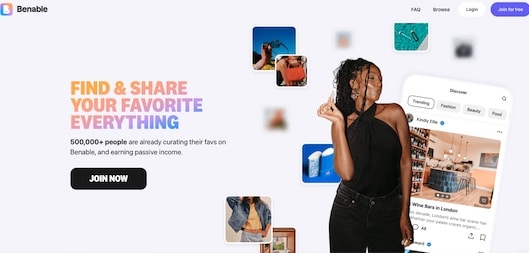
Benable is a recommendation-sharing platform. You create lists of things you genuinely recommend—products, services, places, books, tools, experiences—and then share those lists with other people.
Think of it like a public “favorites list” tool mixed with lightweight affiliate marketing. You’re not writing a full blog post or building an e-commerce store. Instead, you’re curating: “Here are the best things for X,” “Here’s what I use,” “Here’s what I’d buy again,” and so on.
That’s also why Benable appeals to beginners. It promises a path to affiliate-style earnings without requiring you to set up a website, buy hosting, or apply to affiliate networks. In theory, that’s a real advantage.
Still, legit doesn’t automatically mean worth it. A platform can be real, pay some people, and still be a poor use of time depending on the rules and economics.
What Benable offers: two earning options
Benable basically gives you two potential earning routes:
- Recommendation lists(the main feature)
- A referral program(a bonus layer)
Let’s go through both—because the details here determine whether it’s a smart move or a distraction.
Option 1: Recommendation lists (the main way you “earn”)
Here’s the truth in plain English: if you use Benable, you’re doing affiliate marketing.
Affiliate marketing means you share a tracked link to something. If someone buys through that link, you earn a commission. That’s it. There is no magic. There is no guaranteed paycheck. The money follows purchases.
Benable’s version of affiliate marketing looks simple:
- You create a list.
- You add recommendations.
- Benable turns eligible recommendations into affiliate links.
- If a visitor clicks and buys, a commission gets credited to your Benable balance.
This setup is beginner-friendly because you can create lists quickly, and you don’t need technical skills. You can also recommend more than just retail items. In the Benable ecosystem, you can list restaurants, travel destinations, services, experiences, and more.
That flexibility is a genuine plus because it lets you build useful lists around lifestyles and interests, not just shopping.
However, here’s the catch: to earn, your recommendations must connect to stores or brands that Benable can monetize. If the item isn’t in a partner network, it might still be a recommendation, but it won’t necessarily pay.
So if you approach Benable randomly—just adding whatever you like—you might end up with lists that feel fun yet generate little or no revenue.
The “instant approval” advantage (and why it also has a downside)
One reason people get excited about Benable is the promise of instant access to many affiliate programs.
Normally, affiliate marketing looks like this: you apply to networks, get approved, set up links, comply with rules, and wait. With Benable, it can feel like you skip that entire gatekeeping process.
For complete beginners, that’s useful.
At the same time, instant access often comes at the expense of transparency. And that’s one of the biggest problems I see with Benable.
When you promote affiliate offers seriously, you need to know key details like:
- commission rate
- cookie duration
- whether it’s last-click attribution
- restrictions on paid traffic or social platforms
- when commissions become “locked” after refunds
With Benable, those details often aren’t clearly displayed. You end up promoting links without fully understanding the rules behind them. That’s not just annoying—it can affect your strategy, because you can’t optimize properly if you don’t know what you’re optimizing for.
The visibility game: your list won’t earn unless people see it
Benable lists can appear inside Benable’s own feed, and the platform encourages you to make lists detailed so the system can “optimize” them.
That sounds promising, but it also creates a reality check:
Affiliate marketing doesn’t pay you for creating content. It pays you for creating content that gets buyers.
Visibility becomes everything. If you want a list to earn, you need one of two things:
- the platform sends you traffic, or
- you drive traffic yourself.
Benable encourages sharing outside the platform, and that’s sensible. Yet it also exposes the biggest question in this whole business model:
If you have to promote your lists on social media anyway, why do you need Benable?
A website, a YouTube channel, a newsletter, even a simple blog post can do the same job—while giving you more control, more transparency, and often better commission rates.
Option 2: Referral program (the vague bonus)
Benable also offers a referral program. In theory, you earn more when people you refer start earning.
The problem is that referral details are often not explained clearly upfront. The general idea is that you get a bonus linked to the commissions your referrals generate. Reviews have shared that the bonus may only apply for a limited time, such as a couple of months after the referral adds their first recommendation.
If that’s accurate, it narrows the referral program’s window. Your referral has to earn within that window for you to earn anything. And since Benable itself is not a guaranteed earner, you can end up recruiting people who never make a sale—meaning you get nothing.
So yes, referrals might boost results for someone with a big audience and high buyer intent. For most users, it looks more like noise than a reliable earning strategy.
How do you get paid?
Benable credits commissions to your account balance. You can track it through your dashboard.
Then comes the part many people don’t notice until later: the payout threshold.
Multiple reviews and user discussions mention that you may need to reach $80 before you can withdraw. Whether that number changes over time or varies by region, the core issue stays the same: it’s a high threshold compared to most beginner-friendly earning apps.
If you’re making a few dollars here and there, $80 can feel far away. That distance matters because it kills motivation and increases the chance you give up before ever seeing a payout.
As for payout methods, the most common mentions are PayPal and Payoneer. Those are convenient, and I do like the simplicity of that side. Still, a simple withdrawal method doesn’t compensate for a threshold that makes it difficult for the average user to reach the first payout.
How much money can you make with Benable?
The honest answer: it depends on your traffic and your buyers.
That’s not a dodge—it’s the reality of affiliate marketing. If you can send targeted traffic to product recommendations, you can earn. If you can’t, you won’t.
Here’s the bigger issue I can’t ignore: Benable’s internal audience may not be buyer-heavy.
Many people on Benable are there for the same reason you are—to promote their own lists. That tends to create an ecosystem where creators talk to creators, not creators to customers.
Even if Benable provides discovery, the strongest results usually come when you already have an audience somewhere else: TikTok, Pinterest, Instagram, YouTube, or SEO traffic from a blog.
And if you already have that traffic source, Benable becomes optional—not essential.
That’s why I agree with the central criticism from the review you shared: Benable doesn’t provide a strong enough reason to choose it over building your own asset. You still have to do the hardest work—earning trust, creating demand, attracting the right people—so you might as well do it in a place where you control the rules.
Can you use it on mobile?
Yes. Benable has an app for both Android and iOS, and the mobile experience is one of its strongest points.
You can build lists quickly, add recommendations on the go, and manage your profile without needing a computer. For people who hate the idea of building a website, this is probably Benable’s best feature: it makes publishing and sharing frictionless.
Just keep the bigger picture in mind: ease of posting doesn’t equal ease of earning.
Who can join?
Benable is positioned as globally available, and sign-up is straightforward. You can register using email or a Google account, then create your profile and first recommendation.
From there, you can start building lists immediately.
Support and transparency
Benable provides basic support through an FAQ and email support. That’s fine.
The bigger support issue isn’t “Can I contact them?” It’s “Why do I need to contact them in the first place?”
When a platform doesn’t show you clear affiliate program details—commission rates, cookie duration, and important restrictions—it forces serious users to work blind. It also creates uncertainty about the “keep 100%” marketing angle.
Realistically, a middle platform usually earns something. Even if they don’t take a cut from your displayed commission, they may be operating on a different negotiated arrangement. That’s not automatically unethical. It’s just something they should be clear about.
When they aren’t, skepticism is reasonable.
Final verdict and My Recommendation
Benable is a legitimate platform that offers a potential way to earn by recommending things. It has some decent features: it’s easy to use, mobile-friendly, and removes the technical setup for beginners.
Yet it also has clear drawbacks: it doesn’t guarantee earnings, it has a high payout threshold, and it doesn’t provide the transparency that serious affiliate marketers rely on. Most importantly, it doesn’t solve the real problem—getting buyer traffic.
In theory, Benable is not a bad platform. In practice, it often doesn’t give enough reason to build your entire affiliate strategy around it. If you already have traffic and you just want a convenient list tool, it might be useful. If you don’t have traffic, it probably won’t change your situation.
Now, here’s the best solution in my opinion if you actually want clicks and sales instead of hoping a list gets discovered.
If you’re serious about earning with affiliate marketing, start by learning how to build a traffic asset you control—something that brings in targeted visitors consistently (especially from search engines), so your recommendations don’t depend on luck, referral windows, or platform algorithms. That means learning the fundamentals: choosing a niche people actually search for, doing keyword research, creating content that ranks, and placing affiliate links in a way that earns trust and converts.
That’s exactly why I recommend starting with a proper step-by-step platform that teaches you how to build that foundation from scratch—because once you have traffic, you can monetize with Benable or with direct affiliate programs, and you’re no longer stuck relying on a single app.
If you want my top recommended platform for building that traffic-and-sales foundation, you can find it here
Want to Get Paid for Playing Games on Your Phone?
I tested and compared the best reward apps and sites, so you don't waste time on the fake ones. See which ones actually pay, how low the cash-out minimums go, and which offers are worth your time.
- ✅ Low cash-outs, some from just $1
- ✅ PayPal, gift cards and more
- ✅ Games, surveys and simple tasks
- ✅ Honest tips to avoid tracking problems
Earnings aren't guaranteed and results vary. Treat it as a bonus for time you already spend on your phone.