
Arrange Goods 3D Review — Another Match-3 Game Built on Lies
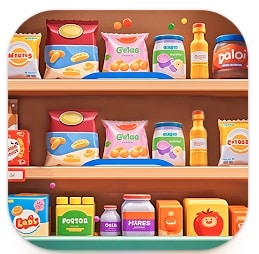 Welcome to my Arrange Goods 3D review!
Arrange Goods 3D comes from KGAME Studio and has pulled in over 100,000 installations on the Play Store. The premise sounds simple enough — drag and arrange goods, match three identical items into the same compartment, complete levels, earn money. Casual, relaxed, and apparently lucrative.
Apparently, being the keyword here.
Because Arrange Goods 3D is another fake cash game dressed up in a match-3 outfit, and the tactics behind it are worth understanding clearly before you waste a single minute of your time on it.
Want to Get Paid for Playing Games on Your Phone?
I tested and compared the best reward apps and sites, so you don't waste time on the fake ones. See which ones actually pay, how low the cash-out minimums go, and which offers are worth your time.
- ✅ Low cash-outs, some from just $1
- ✅ PayPal, gift cards and more
- ✅ Games, surveys and simple tasks
- ✅ Honest tips to avoid tracking problems
Earnings aren't guaranteed and results vary. Treat it as a bonus for time you already spend on your phone.
The Gameplay Is Simple Enough
To give credit where a tiny amount is due, the core mechanic of Arrange Goods 3D is at least functional. You drag items around a 3D space, group three identical goods into the same compartment, and clear the level. There’s a mild satisfaction to the sorting and organising that makes it genuinely playable as a pure puzzle experience.
But nobody is downloading this because they heard it was a great puzzle game. They’re downloading it because somewhere, an advertisement told them they could make real money doing it. And that’s where KGAME Studio’s honesty ends completely.
$30 From Your Very First Level
Complete your first level, and the app rewards you with $30 immediately. Thirty dollars, right out of the gate, for a single round of dragging goods into compartments on a free mobile game.
And if that isn’t exciting enough, a double button appears. Tap it, and your $30 becomes $60. Just like that. No catch — or so it seems at that moment.
That opening reward is expertly calibrated. It’s high enough to feel genuinely significant but not so astronomical that even the most optimistic player dismisses it outright. Thirty dollars feels plausible to someone who hasn’t seen this particular trick before.
It feels like the app is being generous, like you’ve come across something worth pursuing.
What it actually is, is a hook. And it’s very effective.
The $500 Progress Bar Sitting Right at the Top
Here’s something Arrange Goods 3D does that’s worth examining specifically, because it’s a slightly more visible version of the usual withdrawal trap. Right at the top of the screen, there’s a progress bar showing your current balance against a target of $500.
That progress bar is always visible. Always reminding you how far you’ve come and how far you have left to go. It turns the entire experience into a chase, and it does so in a way that’s impossible to ignore because it’s sitting at the top of your screen every single moment you’re playing.
From a mental manipulation standpoint, it’s quite clever. Most fake cash games bury the withdrawal requirement in a menu you have to go looking for. Arrange Goods 3D puts the target front and centre, which paradoxically makes it feel more legitimate. Surely if the $500 was never real, they wouldn’t advertise it so prominently?
They would. And they do. Because that progress bar isn’t a pledge to pay you — it’s a commitment to keep you playing.
Tapping Cards and Doubling Rewards — The Ad Machine Revealed
As you work through levels, the game adds more ways to earn. Tap certain cards and collect extra cash rewards. Complete a level and hit the double button to multiply what you’ve earned. Both of these interactions feel like bonuses, like the game is giving you extra opportunities to accelerate toward that $500 target.
But tap those cards, and a video advertisement plays. Hit the double button after completing a level, and a video advertisement plays. Every single one of these reward interactions is designed to trigger an ad, and that’s not a coincidence — it’s the entire point.
KGAME Studio earns real money every time one of those videos plays. Advertisers pay to show you those clips, and that payment goes directly to the developer. Your $60 reward costs KGAME Studio absolutely nothing, because it was never going to leave their system. The ad revenue, on the other hand, is completely real and flows in reliably every single time you tap a button.
This is the exploitation at the heart of Arrange Goods 3D. They’ve packaged an ad-delivery system inside a match-3 game, attached fictional dollar amounts to keep you engaged, and called it a money-making opportunity. Every minute you spend playing is a minute generating income for them, not for you.
The Rewards Will Drop and the Target Will Stay Out of Reach
Those generous early rewards — the $30 first levels, the easy doubles — don’t last. They never do in apps like this. Once you’re invested enough in your progress bar to keep playing regardless, the payouts quietly start shrinking. Levels that once paid $30 start returning $5. The double button delivers less impressive results. The distance between your balance and $500 stops shrinking and starts feeling permanent.
This is deliberate. The early generosity builds the habit and the hope. The later stinginess keeps you grinding without ever letting you actually arrive. It’s a treadmill, and KGAME Studio designed it that way on purpose.
And the $500 Was Never Real Anyway
Even if you somehow powered through the diminishing rewards, sat through hundreds of video advertisements, and watched your progress bar creep all the way to $500, the outcome wouldn’t be what you’re expecting.
Either new conditions appear that weren’t mentioned before, conveniently extending the journey just a little further. Or your withdrawal request goes nowhere, answered by silence or a support system that isn’t really there.
Because the money displayed on your screen was never backed by anything real. KGAME Studio’s revenue comes from ads, and ad revenue doesn’t stretch to paying out $500 to every player who reaches the threshold. The economics are simply impossible.
The progress bar, the double buttons, the card tapping, the $30 first level — all of it is a funnel designed to maximise the number of ads you watch before you figure out what’s actually happening.
The Bottom Line
Arrange Goods 3D is a functional match-3 puzzle game wrapped around a completely fake cash reward system. KGAME Studio has built an ad revenue machine and disguised it as a money-making opportunity, exploiting the time and attention of over 100,000 players who installed it believing the promise was real.
The $500 progress bar at the top of the screen isn’t a target. It’s a leash. And no matter how many levels you complete, how many cards you tap, or how many video ads you sit through, that $500 is never arriving in your account.
Don’t install it. If it’s already on your phone, delete it now and reclaim your time.
Want to Get Paid for Playing Games on Your Phone?
I tested and compared the best reward apps and sites, so you don't waste time on the fake ones. See which ones actually pay, how low the cash-out minimums go, and which offers are worth your time.
- ✅ Low cash-outs, some from just $1
- ✅ PayPal, gift cards and more
- ✅ Games, surveys and simple tasks
- ✅ Honest tips to avoid tracking problems
Earnings aren't guaranteed and results vary. Treat it as a bonus for time you already spend on your phone.