
Partner.Co Review 2026: Real Earnings Potential (Costs, PV, and the Hard Truth)
 Welcome to my Partner.Co Review!
Someone’s probably pitched you on Partner.Co recently. Maybe they showed you fancy supplements with impressive-sounding science, or talked about noni juice from Tahiti. Perhaps they mentioned “building a partnership that lasts” or showed you how you could earn from multiple income streams. They might have even pulled out their phone to show you the “Power of Four” strategy that supposedly makes everything simple.
If any of this sounds familiar, you’re smart to be doing your homework. Let’s dive deep into what Partner.Co really is, what they’re selling, and most importantly, what you can realistically expect if you decide to join.
Understanding What You’re Getting Into
Before we go any further, here’s the fundamental truth: Partner.Co operates as a Multi-Level Marketing company. If that term is new to you, here’s what it means in plain English. There are two ways to make money. First, you sell products directly to customers and earn commissions. Second, you recruit others to become sellers, and when they sell products, you earn a percentage of their sales, too.
Want to Get Paid for Playing Games on Your Phone?
I tested and compared the best reward apps and sites, so you don't waste time on the fake ones. See which ones actually pay, how low the cash-out minimums go, and which offers are worth your time.
- ✅ Low cash-outs, some from just $1
- ✅ PayPal, gift cards and more
- ✅ Games, surveys and simple tasks
- ✅ Honest tips to avoid tracking problems
Earnings aren't guaranteed and results vary. Treat it as a bonus for time you already spend on your phone.
When those people recruit others, you can earn from those sales as well. This creates multiple “levels” of earning potential. Throughout this review, we’ll be completely honest about how this structure works at Partner.Co and what it really means for your chances of success.
The Company Behind the Opportunity
A Fresh Start or Just a Rebrand?
Partner.Co officially launched in February 2023. However, calling it “new” requires some context. The company was formed by combining four legacy direct-selling companies: ARIIX, LIMU, Morinda, and Zennoa. These companies had been around the MLM world for years.
Here’s what happened. These companies were part of the NewAge/ARIIX business umbrella. John Wadsworth (an experienced distributor) and businessman Darren Zobrist acquired the operation. Wadsworth now serves as chief brand partner officer, while Zobrist took the CEO role. They combined these four companies, rebranded everything, and relaunched as Partner.Co.
The company operates from Midvale, Utah. They report being active in 50 countries, including the United States, Europe, Japan, Korea, Canada, Latin America, Southeast Asia, Africa, the Middle East, and Australia. That’s a substantial global footprint.
The “Partnership” Marketing Angle
Partner.Co markets itself as a “partnership-focused” company. They emphasize the “Brand Partner Bill of Rights,” the Partner Council, and the Founders Club. The stated goal is to give distributors more voice in how things run. The company’s mission is to build “a partnership that lasts.”
The company describes its products as “clinical-quality” and states they’re backed by “over 100 clinical studies and 120 published papers.” They describe their compensation plan as “award-winning.” We’ll examine what these claims mean as we continue.
Important Context: Regulatory Inquiry
In 2023, the U.S. Better Business Bureau’s Direct Selling Self-Regulatory Council (DSSRC) reviewed Partner.Co after receiving reports about certain distributor claims. According to the DSSRC’s publicly available case report, some distributors had made income and product claims that raised concerns.
Partner.Co worked with the DSSRC to address these issues. The company removed the problematic content and implemented a brand-monitoring program. The DSSRC closed the case, reminding the company about FTC guidance on income claims. This information is publicly available in the DSSRC’s case archives and provides important context for prospective distributors.
What Partner.Co Actually Sells
A Diverse Product Catalog
Because Partner.Co combined four companies, they inherited multiple product lines. The result is an extensive catalog across different brands and categories. Let’s break down what you’d be working with.
Nutrifii represents their main line of vitamin and botanical supplements. This is likely where you’ll focus most efforts.
Slenderiiz is their weight-management program, including drops marketed for appetite support and metabolism.
Co.Lab features newer products, including Elite (an adaptogenic supplement) and Max2O (marketed to support cellular hydration).
Tahitian Noni and Temana Noni are juices and concentrates made from the Morinda citrifolia fruit, marketed for antioxidant benefits.
Lucim is their skincare line with moisturizers, serums, and masks.
Reviive covers personal care items like shampoos, conditioners, body wash, and toothpaste.
Puritii includes portable air filtration units and water filter bottles.
Priime is their essential oils line with blends for aromatherapy and topical use.
That’s quite a range. You’re expected to become knowledgeable about supplements, weight management, skincare, personal care, water filtration, air filtration, AND essential oils. Many people find it challenging to become genuinely knowledgeable about even one of these categories.
Understanding the Pricing
Based on publicly available pricing from European distributors, here are some examples of Nutrifii products:
- Renew: €128.11 (about $138 USD)
- Day & Night drops: €168.03 (about $181 USD)
- Carboniix: €110.76 (about $120 USD)
- PureNourish: €99.47 (about $107 USD)
- Vinali: €58.78 (about $63 USD)
Bundle packs combining multiple supplements range from €220 to €489 (roughly $237 to $527 USD).
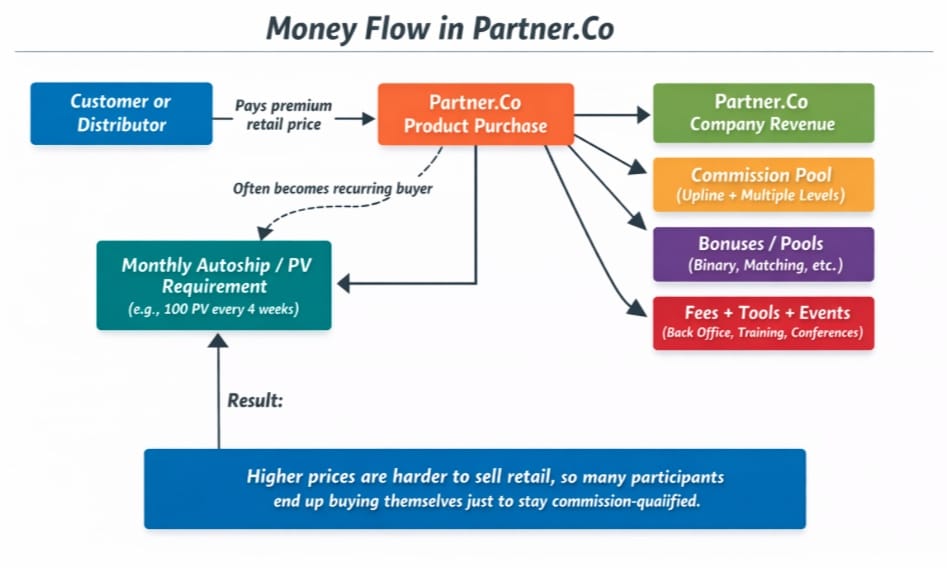
These represent premium pricing in the supplement market. For comparison, many health food stores offer similar supplements at lower price points. The price difference typically reflects the MLM business model, where a portion of the retail price goes toward paying commissions throughout the distributor network.
How the Money Actually Flows
Before moving on, it helps to visualize where a product purchase actually goes inside an MLM like Partner.Co.
A Closer Look at One Product: Nutrifii Vináli
Let’s examine one specific product. Vináli is marketed as a broad-spectrum antioxidant blend. Each bottle contains 56 capsules and costs €58.78 (about $63 USD).
The formula combines 315 mg of vitamin C from natural sources like acerola cherry, amla, and green pepper. It includes grape seed and grape skin extracts plus citrus bioflavonoids. The product information states that vitamin C helps protect cells from oxidative stress and supports collagen formation.
The product is vegan, gluten-free, halal, and has certifications from NSF and Informed Sports. These certifications do indicate third-party quality verification.
This is essentially a vitamin C supplement with grape extract and bioflavonoids. Similar products are available at various price points in the market. The pricing reflects Partner.Co’s distribution model.
The Weight Management Program
The Slenderiiz program includes drops marketed for weight management support. It’s worth noting that homeopathic products are a subject of ongoing scientific discussion. The FDA states that homeopathic products are not evaluated for safety and effectiveness. Some countries have specific regulations regarding health claims for such products.
As a distributor, you would need to be careful about what claims you make regarding these products. The regulatory landscape around weight loss and homeopathic products can be complex.
The Noni Juice Products
The Tahitian Noni and Temana Noni products are made from Morinda citrifolia fruit. These are marketed for their antioxidant content. The fruit has traditional use in Polynesian cultures.
According to the DSSRC case information, some distributors had previously made health claims about noni that went beyond what’s supported. As a distributor, staying within approved marketing language would be important.
The True Cost of Getting Started
The Initial Investment
Partner.Co requires a Brand Partner Media Kit purchase of approximately $29.95. This provides access to their back-office system and marketing tools. The kit doesn’t include products—just system access.
Activation Requirements
To activate an income position and start earning most commissions, you need to accumulate at least 200 Point Volume (PV). This can come from personal purchases or retail sales. For new distributors without an existing customer base, this typically means initial product purchases.
According to distributor training materials available online, enrollment packs include:
- Lifeboat Slenderiiz pack: 208 PV, approximately $371
- Slenderiiz 10-pack: 500 PV, $879.95
- Diamond pack: 1,500 PV, $2,249
These packs contain various products and materials. The “Ultimate” business level requires 1,500 PV, which represents the Diamond pack investment level.
The Ongoing Requirement
To remain commission-qualified, distributors must generate 100 PV every four weeks. That’s 13 cycles per year, not 12 monthly cycles.
Many distributors use auto-ship subscriptions at 100 PV per month to maintain qualification. Based on product pricing, this likely represents $100-150 per month, or approximately $1,300-1,950 annually.
This is a common pattern in MLM companies. Distributors often purchase products themselves to maintain qualification, particularly in the early months before building a customer base. This means many distributors become significant customers of the products they’re selling.
How the Compensation Plan Works
The Business Structure
Partner.Co’s compensation plan combines several elements including binary structures, unilevel components, and various bonuses. Let’s break this down clearly.
Business Levels
The plan defines four business levels based on PV accumulated in the first four weeks:
- Activated: 200 PV (roughly $350-400)
- Business: 500 PV (roughly $880)
- Elite: 1,000 PV (roughly $1,500-1,800)
- Ultimate: 1,500 PV (roughly $2,249)
Higher levels unlock larger commission percentages on various bonuses. This creates an incentive to start at a higher level.
Earning Methods
Retail Profits: Distributors can buy at wholesale and sell at retail, with margins potentially reaching 30% with subscription pricing.
New Volume Bonus: Partners earn percentages on purchases made by new customers and distributors in their first four weeks:
- Activated: 15%
- Business: 20%
- Elite: 25%
- Ultimate: 30%
Base Commissions: A binary structure pays 15% on each pay line’s group volume, with a cap of $2,000 per pay line per week.
Savings Bonus: The company withholds 15% of base commissions in a savings account. When the balance reaches $10,000, distributors receive a $10,000 bonus, then $500 every four weeks thereafter.
Income Position Bonus: 2% of worldwide PV is pooled and distributed to partners with optimized income positions (balanced legs). Shares are valued around $250.
Pay Line Bonus: 1% pool for partners creating pay lines beyond the first two, with shares around $400.
Matching Bonus: Percentages of team members’ base commissions up to seven generations deep, depending on rank.
Business Rewards and Loyalty Credits: Credits earned through various activities, redeemable for cash, trips, products, or donations.
The Binary Structure Challenge
The binary structure requires building and balancing two legs. If one leg produces significant volume while the other remains weak, earnings aren’t maximized. This requires strategic placement of recruits and constant attention to team balance.
The Savings Account Feature
The 15% withholding creates a savings account that distributors can’t access until reaching $10,000. For many distributors who don’t remain active long enough to reach this threshold, these withheld commissions become inaccessible.
The “Power of Four” Strategy
Partner.Co promotes a “Power of Four” approach:
- List 10 potential recruits
- Download the Partner.Co Share app
- Recruit four people
- Achieve 5,000 PV in the first eight weeks
Gold status (200 PV to four new customers or partners) unlocks three generations of matching bonus. Higher levels unlock additional generations.
The mathematics of this approach: You recruit four people. Those four each recruit four (16 people). Those 16 each recruit four (64 people). That’s 84 people total in your organization.
However, industry statistics show approximately 50% of MLM participants leave within their first year. Maintaining this structure requires ongoing recruitment to replace those who leave.
What Research Says About MLM Success Rates
Industry-Wide Statistics
Multiple studies by economists, consumer advocates, and government agencies have examined the MLM industry. The data reveals important patterns:
Research indicates that approximately 73-99% of people who join MLM companies either lose money or make no profit. Even among those who do make some profit—roughly 25% of all participants—earnings tend to be modest. Studies show that half of profitable participants earn less than $370 annually.
About 50% of MLM participants leave within their first year. By five years, approximately 90% have exited. Only about 3-4% of MLM participants earn $25,000 or more annually, and less than 1% earn over $100,000 per year.
Understanding These Numbers
These statistics reflect the MLM industry broadly across hundreds of companies and millions of participants over decades. Partner.Co, having launched in 2023, hasn’t published income disclosure statements yet, so company-specific data isn’t available.
The business model—where most participants are positioned at the bottom of a pyramid-shaped structure—creates mathematical challenges for widespread profitability. The model works when most participants also function as customers, which means many people spend more than they earn.
Real Experiences: What People Say
Positive Testimonials
Some distributors share positive experiences. Common themes in these testimonials include appreciation for the community culture, corporate support, and product quality. Some describe the events as valuable and feel the compensation plan offers good earning potential.
These testimonials represent real experiences. However, it’s worth noting that satisfied participants are typically more vocal than those who have neutral or negative experiences.
Critical Perspectives
Industry analysts and health professionals have raised various concerns:
Some nutrition experts have questioned certain product claims, particularly regarding homeopathic ingredients in weight management products. The scientific community continues to debate the efficacy of homeopathy.
Some critics note that MLM business models, including Partner.Co’s binary and “Power of Four” approach, can create significant emphasis on recruitment. The substantial upfront investments combined with limited income disclosure information can make it challenging for prospective distributors to assess realistic earning potential.
The 2023 DSSRC case provides documented evidence that some distributors made income and health claims that required attention. While Partner.Co addressed these issues, it demonstrates the ongoing challenge of ensuring compliant marketing across a distributed sales force.
Who Might Find Success
The Realistic Profile
Based on industry research and MLM business model characteristics, certain factors correlate with higher success probability:
Previous MLM experience significantly increases success likelihood. Those who have built network marketing businesses understand the skills, time commitment, and emotional resilience required.
Strong sales abilities are essential. This includes comfort with rejection, relationship-building skills, and maintaining consistent follow-up.
Substantial social networks provide access to potential customers and recruits. A limited social circle can make MLM success particularly challenging.
Financial resources matter significantly. The ability to invest $2,000-$5,000 in the first year without financial stress—covering enrollment, monthly auto-ship, events, and marketing—is important.
Time availability of 15-30 hours weekly while maintaining other income is typically necessary, as most distributors don’t replace full-time income quickly, if ever.
Realistic expectations are crucial. Understanding this as a high-risk venture without guaranteed returns is essential for informed decision-making.
Important Questions to Ask
Before making any financial commitment, ask your potential sponsor:
- What’s the exact cost to start at each business level, including all fees and required purchases?
- How much have you personally earned monthly for the past 12 months? (Request documentation)
- How much have you spent on products, training, events, and business expenses during that period?
- What percentage of your purchases are for personal use versus sold to customers outside your organization?
- How many people have you recruited, and what percentage remain active after one year?
- How many hours weekly do you dedicate to this business?
- Can you share Partner.Co’s income disclosure statement?
- What happens if I can’t maintain the 100 PV requirement every four weeks?
- Can I succeed focusing solely on retail sales without recruiting?
If responses are defensive, vague, or irritated, that provides important information for your decision-making process.
Alternative Business Models
Before committing, consider these alternatives:
E-commerce: Operating your own online store provides control over pricing, products, and customer relationships without recruitment requirements.
Affiliate marketing: Promoting various companies’ products earns commissions without monthly purchase requirements or recruiting quotas.
Professional services: Offering skills-based services (consulting, coaching, design, programming) generates income based on expertise rather than recruitment.
Traditional retail: Many wellness brands offer wholesale accounts without multi-level structures.
Content creation: Building audiences through YouTube, blogs, or social media can generate income through multiple streams.
These alternatives typically involve lower ongoing costs, no mandatory monthly purchases, and don’t depend on recruiting personal contacts.
The Bottom Line
Understanding What You’re Considering
Partner.Co is a legally operating MLM company selling actual products. It’s not an illegal pyramid scheme. However, legality and opportunity quality are different considerations.
The company formed by combining four existing direct-selling companies and launched in 2023. Early in its operation, the DSSRC reviewed distributor claims, which the company addressed. Partner.Co hasn’t yet published income disclosure statements showing typical distributor earnings.
The products are priced at premium levels. Some product claims, particularly around homeopathic ingredients, exist within areas of scientific discussion. The 100 PV monthly requirement creates ongoing purchase pressure. Many distributors may find themselves spending more on maintaining qualification than they earn in commissions.
The compensation plan is complex, combining binary, unilevel, and bonus structures. The “Power of Four” approach requires building and maintaining a substantial, active organization. The 15% savings withholding creates a threshold most distributors may never reach.
What This Means
For the majority of people considering Partner.Co, the statistics suggest challenging odds for profitability. The business model is high-risk, requires significant time and financial investment, and success rates across the MLM industry are low.
The “partnership” language is appealing marketing. Product quality varies. The compensation plan offers multiple earning methods, but all require substantial personal volume and team building. Positive community experiences don’t necessarily translate to financial success.
A Thoughtful Recommendation
For most readers, careful evaluation and comparison with other opportunities is warranted.
Those who genuinely enjoy the products can remain customers without becoming distributors. This eliminates qualification pressures and recruitment requirements.
Those attracted primarily to the business opportunity should understand the industry statistics clearly. Most participants spend more than they earn. Costs compound, time commitment grows, and relationship strain is common.
If proceeding despite these considerations:
- Start at the minimum level, not expensive enrollment packs
- Set firm budgets and track every expense and payment
- Evaluate by profit after costs, not revenue
- Set a trial period (6-12 months) with clear exit criteria
- Protect relationships and avoid unapproved claims
- Verify information independently
- Base decisions on facts and realistic expectations
Sustainable business success requires time, skill, effort, and often favorable circumstances. Be cautious of anyone suggesting otherwise.
Disclaimer: This review is for informational and educational purposes only. It should not be considered financial or business advice. We are not affiliated with Partner.Co. All information is based on publicly available sources, company materials, regulatory filings, and industry research. Individual results vary significantly. Statistical data reflects industry-wide research. Always conduct thorough independent research and consult with qualified professionals before making business or financial decisions.
Want to Get Paid for Playing Games on Your Phone?
I tested and compared the best reward apps and sites, so you don't waste time on the fake ones. See which ones actually pay, how low the cash-out minimums go, and which offers are worth your time.
- ✅ Low cash-outs, some from just $1
- ✅ PayPal, gift cards and more
- ✅ Games, surveys and simple tasks
- ✅ Honest tips to avoid tracking problems
Earnings aren't guaranteed and results vary. Treat it as a bonus for time you already spend on your phone.